
The Real Costs of Car Ownership That Go Beyond the Monthly Payment

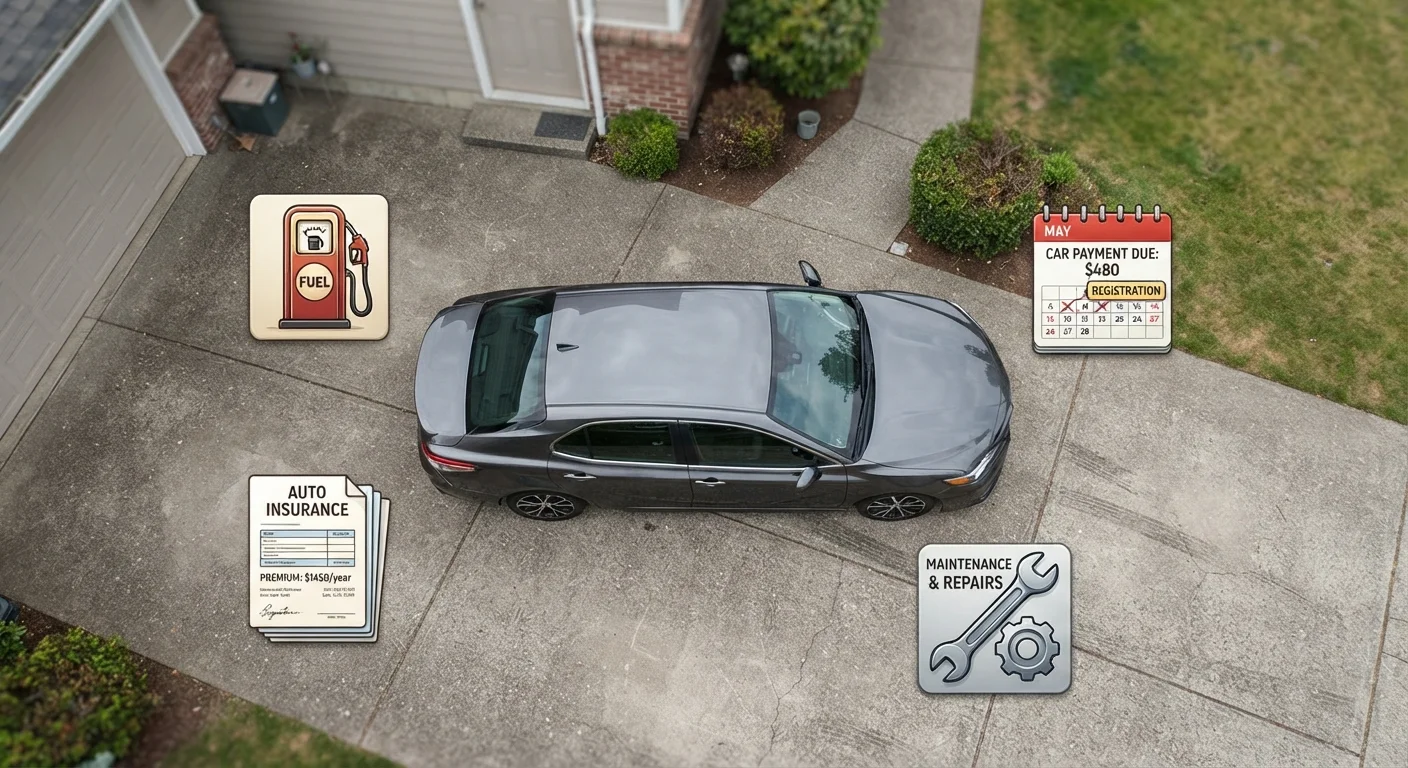
Photo: usewiseguide.com editorial
Key Takeaways
- The monthly loan payment typically covers less than half of what a car actually costs each year.
- Depreciation is usually the single largest ownership expense, often exceeding fuel and insurance combined.
- Insurance premiums vary widely based on your driving record, location, and coverage choices.
- Routine maintenance done on schedule generally costs far less than deferred repairs.
- Fuel economy differences between vehicles can add up to thousands of dollars over several years of ownership.
Why the monthly payment is the wrong number to focus on
When families shop for a vehicle, the monthly loan payment tends to dominate the conversation. Lenders and dealers present it as the key affordability measure, and it feels concrete. The problem is that a monthly payment only reflects the principal and interest on the loan. It tells you almost nothing about what the car will actually cost to operate.
A more useful frame is the total cost of ownership: every dollar the vehicle will pull from your budget over the years you drive it. For most families, that number is substantially higher than the payment suggests. Understanding each component beforehand can help you choose a vehicle that fits your real budget, not just a number that fits the monthly cash flow.
The Smart Auto Ownership hub covers the full range of strategies for managing these costs once you already have a vehicle.
The five major cost categories every owner faces
Depreciation. This is the cost most families overlook because no bill arrives in the mail. Depreciation is the value your car loses over time. A vehicle that costs $32,000 new and sells for $18,000 five years later has generated $14,000 in depreciation expense, roughly $2,800 per year. Higher-volume mainstream vehicles tend to hold value more consistently than low-volume specialty models, though every car depreciates.
Insurance. Premiums depend on your state, your driving history, your coverage levels, and the specific vehicle. Comprehensive and collision coverage on a financed car is typically required by the lender, which limits how much you can reduce this line. Annual review of your policy and coverage limits is one of the few levers available to most drivers.
Fuel. Fuel cost is the most variable expense because it reflects both local prices and how you drive. A vehicle rated at 28 miles per gallon costs meaningfully less to fuel each year than one rated at 19 mpg, especially for families with longer commutes. The math is straightforward: estimate your annual mileage, divide by the vehicle's fuel economy rating, and multiply by a reasonable fuel price estimate.
Maintenance and repairs. Scheduled maintenance, oil changes, tire rotations, brake service, and filter replacements are predictable and relatively inexpensive when done on time. Deferred maintenance tends to convert inexpensive problems into expensive ones. Setting aside a fixed monthly amount in a dedicated savings account smooths out these costs over time.
Registration, taxes, and fees. These vary considerably by state but add a consistent annual line to ownership costs. Some states charge annual property taxes on vehicle value; others charge flat registration fees. Both should be factored into your budget before purchase.
$12,000+
Estimated average annual car ownership cost
The American Automobile Association has estimated total ownership costs for a new vehicle, including depreciation, fuel, insurance, and maintenance, at over $12,000 per year for average US drivers.
~20%
Value lost in year one for many new cars
Industry data consistently shows many new vehicles lose roughly 15 to 20 percent of their purchase value within the first 12 months of ownership.
9 cents
Per-mile fuel cost difference at 19 vs. 28 mpg
At $3.50 per gallon, a vehicle rated at 19 mpg costs approximately 18 cents per mile in fuel versus about 13 cents for a 28-mpg vehicle, a gap that grows with annual mileage.
How depreciation actually works
Depreciation is not a straight line. Most vehicles lose value fastest in the first two to three years, then the rate slows. This pattern is why a two-year-old used vehicle can offer similar transportation for a lower total cost than a new one: someone else absorbed the steepest part of the depreciation curve.
The practical implication is that a vehicle's price tag does not predict its depreciation rate. Some vehicles hold value well because demand stays strong in the used market. Others drop quickly. Checking historical resale values for a specific model before purchase gives a better picture of what the depreciation line will look like for your situation.
It is also worth noting that depreciation affects your financial position differently depending on whether you own the vehicle outright or carry a loan. If a car depreciates faster than you pay down the loan balance, you end up owing more than the car is worth, a condition sometimes called being underwater on the loan. This limits your options if you need to sell or if the vehicle is totaled.
Practical ways to think about these costs before you commit
Before finalizing any vehicle decision, it helps to build a simple annual cost estimate. Add up a realistic insurance premium, a fuel cost based on your expected mileage, a maintenance budget (many financial planners suggest setting aside between 1% and 2% of the vehicle's value annually as a starting point for older vehicles), and your registration costs. Then add an estimated annual depreciation figure based on historical data for that model. Compare the resulting total against your actual budget, not just the monthly payment.
Some families find that a slightly less expensive vehicle with better fuel economy or lower insurance costs results in a lower total annual expense than a vehicle with a lower sticker price but higher operating costs. These tradeoffs are worth mapping out explicitly.
There are also widely held beliefs about vehicle costs that do not hold up under scrutiny. The auto ownership myths article covers several that can lead families to overspend.
The concept of total cost of ownership applies to other household purchases as well. The renting vs. owning tools guide applies similar thinking to home project equipment.
This article provides general financial information for educational purposes. It is not personalized financial advice. Consult a qualified financial professional for guidance specific to your situation.
Frequently Asked Questions
The content provided on our blog site traverses numerous categories, offering readers valuable and practical information. Readers can use the editorial team’s research and data to gain more insights into their topics of interest. However, they are requested not to treat the articles as conclusive. The website team cannot be held responsible for differences in data or inaccuracies found across other platforms. Please also note that the site might also miss out on various schemes and offers available that the readers may find more beneficial than the ones we cover.