
Why Affordable Makeup Sometimes Performs Differently Than Pricier Counterparts

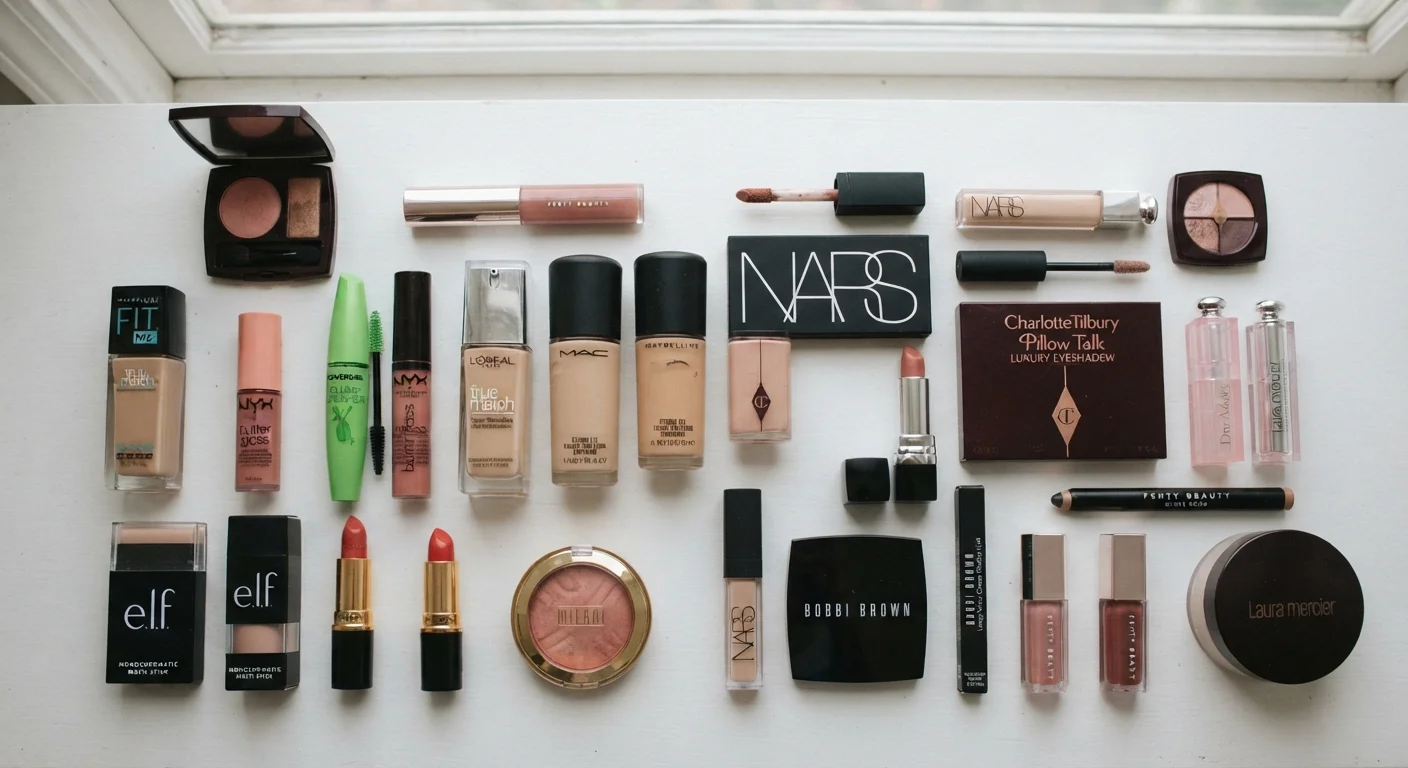
Photo: usewiseguide.com editorial
Key Takeaways
- Pigment concentration and ingredient quality are the main drivers of performance differences between price tiers.
- Some product categories, such as pressed powders and pencil liners, show smaller performance gaps across price points than others.
- Higher price does not guarantee better performance; marketing, packaging, and brand positioning also add to cost.
- Reading ingredient lists is a practical way to compare products across price points before buying.
- Certain affordable products are manufactured in the same facilities as pricier counterparts, using comparable base formulas.
What actually goes into a makeup product
Every makeup product is a mixture of functional ingredients: pigments that provide color, binders that hold the formula together, emollients that affect texture and feel, and preservatives that extend shelf life. The specific ingredients chosen and the concentration at which they appear determine nearly everything about how a product performs on skin.
At the manufacturing level, cosmetics across all price points follow the same basic chemistry. A drugstore lipstick and a department store lipstick both rely on waxes, oils, and pigments. The differences lie in which waxes, how refined the oils are, how finely the pigments are milled, and what proportion of the formula each component occupies.
Finely milled pigments disperse more evenly and can look more natural on skin. Higher-quality emollients may feel lighter or more comfortable over hours of wear. These ingredient choices cost more to source, and that cost is reflected in the retail price. But manufacturing overhead, packaging, celebrity partnerships, and advertising also add to what a consumer pays.
Where the performance gap shows up most
The gap between affordable and pricier makeup is not uniform across every product category. It tends to be most noticeable in formulas where precision matters: full-coverage foundations, long-wear liquid lipsticks, and cream-based eyeshadows that require specific emollient ratios to avoid creasing.
In these categories, a lower pigment load means the product may need more product applied to achieve comparable coverage, which can affect finish and feel. Binder quality in pressed products affects whether a powder fractures easily or survives daily use in a bag.
By contrast, products with simpler formulas show smaller performance differences. Pencil eyeliners, setting sprays with straightforward alcohol and water bases, and basic lip balms often perform comparably whether purchased at a pharmacy or a department store counter. See a category-by-category breakdown of where savings are most realistic across a full makeup routine.
Read the label before you reach for your wallet
Why price is not a reliable proxy for quality
A significant portion of a prestige product's retail price reflects costs that have nothing to do with what is inside the tube. Luxury packaging, retailer margins, fragrance licensing, and marketing budgets all factor into what consumers pay. A product can be priced at three times the cost of a comparable drugstore item and still share a nearly identical base formula from the same contract manufacturer.
This is not unusual. A relatively small number of large contract manufacturers supply cosmetics formulas to brands across price tiers. The base may be the same; the differences are often in pigment load, added fragrance, and how the product is positioned and packaged for sale.
That said, higher price does sometimes correspond to meaningful formulation investment, particularly in skincare-adjacent products like tinted moisturizers or BB creams where active ingredient concentrations matter. The relationship between price and performance is real but inconsistent, not automatic. For a parallel in another category, see how cutting costs on paint jobs can produce a similar disconnect between upfront savings and actual results.
How to compare products across price points
The ingredient list is the most direct tool available to consumers. In the United States, cosmetics must list ingredients in descending order of concentration under FDA rules. An ingredient that appears in the top five is present in a meaningfully higher amount than one listed near the bottom.
When comparing two foundations, look at where skin-conditioning ingredients and pigments appear relative to fillers. If a more expensive product lists beneficial ingredients higher on its label, that may justify the cost difference. If both products list the same functional ingredients in a similar order, the price gap is more likely to reflect brand positioning than formulation.
Community reviews from people with comparable skin types and concerns can also provide performance data that neither the price tag nor the packaging reliably delivers. Building a morning skincare routine on a budget covers similar label-reading principles for skincare products. Understanding the difference between frugal and cheap applies here too: choosing a lower-cost product after comparing ingredient lists is a considered decision, not a compromise.
~80%
Cosmetics made by third-party contract manufacturers
Industry estimates suggest the majority of cosmetics brands, across all price tiers, outsource production to a relatively small number of specialized contract manufacturers.
Top 5
Ingredient list position that signals meaningful concentration
Under FDA rules, cosmetic ingredients must be listed in descending order of concentration; ingredients in the top five positions are present at the highest levels in the formula.
Frequently Asked Questions
The content provided on our blog site traverses numerous categories, offering readers valuable and practical information. Readers can use the editorial team’s research and data to gain more insights into their topics of interest. However, they are requested not to treat the articles as conclusive. The website team cannot be held responsible for differences in data or inaccuracies found across other platforms. Please also note that the site might also miss out on various schemes and offers available that the readers may find more beneficial than the ones we cover.