
Digital Coupons vs. Paper Coupons: Which Saves More at the Checkout?

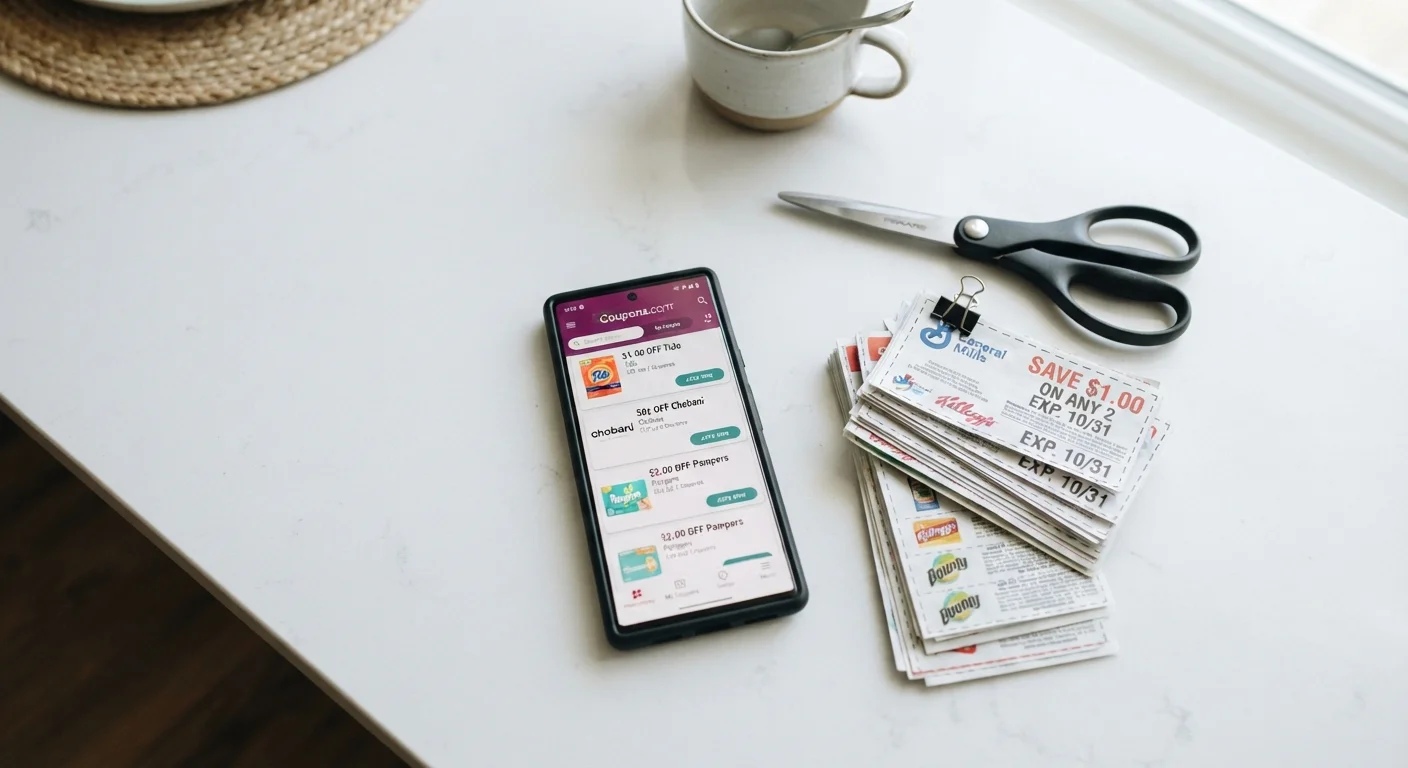
Photo: usewiseguide.com editorial
Key Takeaways
- Digital coupons typically load to a store loyalty card and apply automatically at checkout.
- Paper coupons require physical handling but are accepted at nearly all grocery and drugstore chains.
- Stacking paper and digital coupons together, where store policy allows, can produce the largest combined discount.
- Digital formats reduce the risk of forgetting a coupon at home, but expired offers can still slip by unnoticed.
- Paper coupons still appear in Sunday inserts and direct mail, covering categories digital platforms sometimes skip.
- Neither format outperforms the other across all situations; your store's policies determine which saves more.
How each format actually works
Digital coupons live inside a retailer's app or website. A shopper browses available offers, selects the ones that match their list, and the discount applies when the loyalty card or phone number is entered at the register. No paper changes hands. The coupon either reduces the item price automatically or appears as a post-transaction credit, depending on the store.
Paper coupons arrive through newspaper inserts (mainly Sunday editions), direct-mail packets, in-store tear pads, and sometimes on product packaging. The shopper clips or tears them out, keeps them organized until the shopping trip, and hands them to the cashier or feeds them into the self-checkout scanner. A valid coupon shows the product name, discount amount, expiration date, and a barcode the register can read.
Both formats depend on the retailer accepting the coupon type. Some smaller independent grocers honor paper manufacturer coupons but have no digital program. Large chains tend to run both systems simultaneously, which opens the door to stacking. See the pre-purchase checklist for a quick way to confirm a deal is worth acting on before you get to the register.
| Criterion | Digital coupons | Paper coupons |
|---|---|---|
| Where to find them | Retailer apps and websites | Sunday inserts, direct mail, in-store pads |
| Portability across stores | Store-specific only | Manufacturer coupons accepted widely |
| Ease of use at checkout | Applies via loyalty card or phone number | Hand to cashier or scan at self-checkout |
| Risk of forgetting | Low (stored on account) | Higher (must bring physical copy) |
| Update frequency | Continuous throughout the week | Weekly or bi-weekly print cycles |
| Account required | Yes, loyalty account needed | No account required |
| Stacking potential | Often pairs with paper manufacturer coupons | Often pairs with digital store coupons |
| Category coverage | Strong on promoted and store-brand items | Broader mix including niche categories |
Where paper coupons hold an edge
Paper manufacturer coupons are retailer-agnostic. A coupon printed in a Sunday insert can, in principle, be used at any participating store that accepts manufacturer coupons, which includes most major grocery and drug chains. That portability matters for families who split their shopping across several stores based on weekly sales.
Coverage is another factor. Sunday inserts carry a broad mix of product categories: cleaning supplies, personal care, pet food, and shelf-stable groceries. Digital platforms at individual retailers tend to feature their own store brands and promoted national brands more heavily, so niche or less-promoted products sometimes appear only in print.
Paper coupons also work without a smartphone, an app account, or a data connection. For households that prefer not to share personal data with a retailer's loyalty program, clipping from a printed insert requires no registration. This matters in the context of how loyalty programs actually work and what you trade for their discounts.
Where digital coupons hold an edge
Digital coupons eliminate the physical logistics of couponing. Forgetting a clipped coupon at home, finding that it expired last Tuesday, or discovering a tear in the barcode are problems that disappear when the offer is stored on an account. The app remembers what you clipped and applies it automatically if the qualifying item is purchased before the expiration date.
Digital offers also update continuously. Retailers push new offers throughout the week, not just on a print cycle. That means a sale on produce or dairy can carry a matching digital coupon without waiting for the next Sunday insert. Some stores also send personalized offers based on purchase history, which can generate discounts on products the household already buys regularly.
For families tracking their grocery habits, digital coupons pair naturally with tools covered in grocery spending patterns because both run through an app that records what you bought and when. The data can help you spot where coupon savings are actually landing versus where you assumed they were.
91%
U.S. shoppers who use digital coupons
According to a Statista consumer survey, around 91% of American shoppers reported using digital coupons in a recent survey period.
$1,800+
Estimated annual savings per household from couponing
The Coupon Information Corporation has noted that consistent coupon use across grocery and household categories can represent significant annual savings for an average household, though results vary by shopping volume and strategy.
Stacking, store policy, and the real savings ceiling
The largest discounts at the register usually come from combining a sale price with at least one coupon. Many large grocery chains allow one manufacturer coupon (paper or digital) plus one store coupon per item. Where both a paper manufacturer coupon and a digital store coupon apply to the same product, using both simultaneously, called stacking, can produce a discount larger than either alone.
Store policy governs what is allowed. Retailers set their own rules on whether paper and digital coupons can be combined, and those rules change. Checking the store's current coupon policy before a trip, usually available on the retailer's website, prevents a rejected coupon at the register. Beyond coupons, cashback programs and rebates can layer additional savings on top of whatever coupon discount the store applies, making the combined total higher than any single method alone.
Neither digital nor paper coupons are inherently more valuable. The format that saves more is the one that matches your store's policy, your product list, and your willingness to manage the process week to week.
Check the store's doubling policy
The content provided on our blog site traverses numerous categories, offering readers valuable and practical information. Readers can use the editorial team’s research and data to gain more insights into their topics of interest. However, they are requested not to treat the articles as conclusive. The website team cannot be held responsible for differences in data or inaccuracies found across other platforms. Please also note that the site might also miss out on various schemes and offers available that the readers may find more beneficial than the ones we cover.